
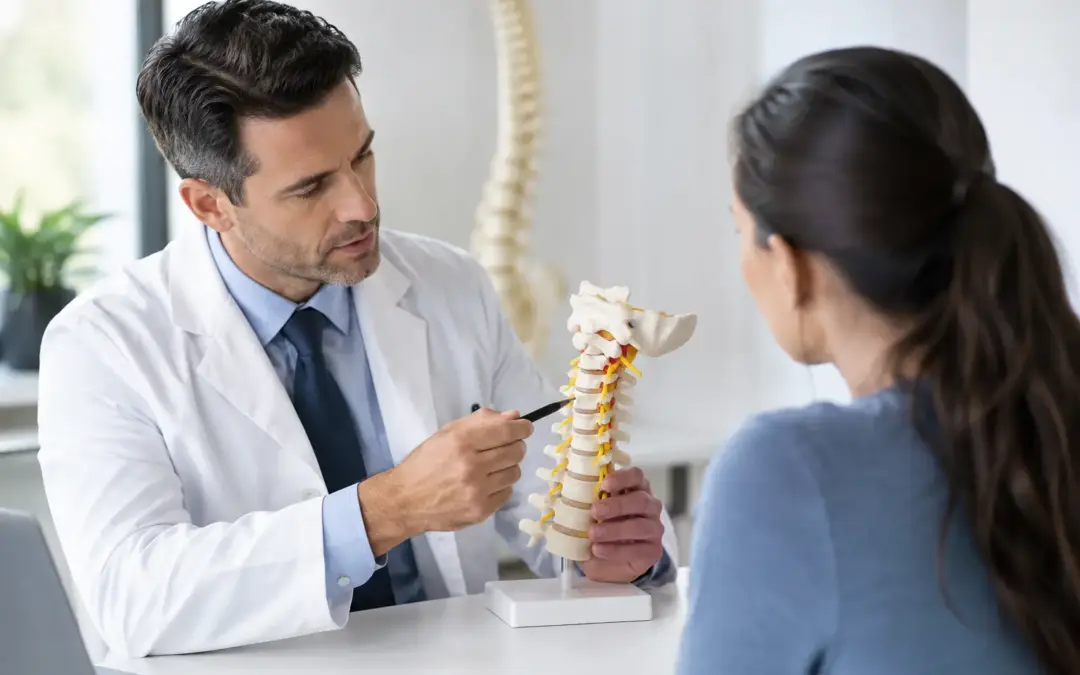
Pain that begins in the neck and shoots into the shoulder, arm, or hand can make even simple tasks feel uncertain. If numbness, weakness, or burning pain persists despite conservative treatment, this guide to cervical radiculopathy surgery can help you understand why surgery may be recommended, what options exist, and how to make a confident decision.
Cervical radiculopathy occurs when a nerve root in the neck becomes irritated or compressed. The pressure may come from a herniated disc, bone spurs caused by arthritis, narrowing around the nerve, or degeneration that reduces the space available for the nerve to travel. Symptoms often follow a specific nerve pathway, which is why a patient may feel pain in the neck but weakness or tingling primarily in the arm, fingers, or hand.
When Cervical Radiculopathy Surgery Becomes an Option
Most patients do not need immediate surgery. Many improve with time, activity modification, physical therapy, anti-inflammatory medication, or targeted injections. Surgery enters the discussion when those measures have not provided meaningful relief and symptoms continue to limit work, sleep, independence, or quality of life.
A more urgent evaluation may be needed when arm or hand weakness is progressing, fine motor control is deteriorating, or imaging shows significant nerve or spinal cord compression. Severe pain alone can also be a reasonable reason to consider surgery when it remains disabling after appropriate non-surgical care.
The decision should never be based on an MRI alone. Degenerative findings are common, especially after middle age, and not every abnormality causes symptoms. A qualified spine surgeon compares your scan with your physical exam, symptom pattern, medical history, and response to prior treatment. The goal is to identify the exact level causing the problem and determine whether surgery is likely to address it.
What Surgery Is Designed to Treat
Cervical radiculopathy surgery is generally a decompression procedure. In plain language, the surgeon creates more room for the compressed nerve. The approach and implant choice depend on where the pressure is located, how many levels are involved, the condition of the facet joints, spinal alignment, stability, bone quality, and whether there is spinal cord involvement.
For many patients, the surgery is performed through a small incision at the front of the neck. This approach gives the surgeon direct access to the damaged disc and the nerve compression while avoiding major neck muscles. In other cases, particularly when compression is positioned toward the back or side of the spine, a posterior approach may be more appropriate.
Relief of radiating arm pain can occur relatively quickly after successful nerve decompression. Numbness and weakness may improve more gradually because nerves heal slowly. When nerve compression has been severe or long-standing, some symptoms may not fully resolve. This is one reason timely expert assessment matters.
The Main Surgical Options
Cervical Artificial Disc Replacement
Cervical artificial disc replacement, also called cervical disc arthroplasty, involves removing the damaged disc and replacing it with a motion-preserving implant. The implant is designed to maintain movement at the treated level while restoring disc height and relieving pressure on the nerve.
For the right candidate, disc replacement can be an appealing alternative to fusion. Preserving motion may help patients return to comfortable movement and may reduce stress transferred to neighboring levels, although no procedure can guarantee that future degeneration will not occur. It is most often considered for one or two diseased levels in patients with good spinal alignment, adequate bone quality, and no advanced facet joint arthritis or major instability.
Disc replacement is not automatically the best choice simply because it preserves motion. If the spine is unstable, significantly collapsed, severely arthritic, or poorly aligned, a fusion may provide a safer and more durable solution.
Anterior Cervical Discectomy and Fusion
Anterior cervical discectomy and fusion, commonly called ACDF, is one of the most established operations for cervical radiculopathy. The surgeon removes the problematic disc and decompresses the nerve, then places a spacer or graft between the vertebrae. A plate and screws may be used to stabilize the area while the bones heal together.
Fusion eliminates motion at the treated segment, which is a trade-off. However, it can be an excellent choice when stability is needed or when the anatomy does not support an artificial disc. Many patients achieve substantial pain relief and return to active lives after ACDF. The best procedure is not the one with the newest name. It is the one that matches your anatomy and clinical needs.
Posterior Cervical Foraminotomy
A posterior cervical foraminotomy reaches the nerve from the back of the neck. The surgeon removes bone or disc material that is narrowing the foramen, the opening where the nerve exits the spine. Because the disc itself may remain in place, this procedure can preserve motion without an implant in selected cases.
This approach is often considered when compression is mainly on one side and located near the nerve exit. It may not be suitable for central compression, significant instability, or conditions affecting multiple levels.
Preparing for a Safer Surgical Experience
A trustworthy surgical plan starts well before the operating room. Your medical team should review high-quality imaging, medications, prior neck procedures, heart and lung health, diabetes control, smoking status, and any history of bleeding or blood clots. Patients who smoke are usually advised to stop, particularly when fusion is planned, because nicotine can interfere with bone healing.
Ask direct questions about the recommended procedure: Which level is causing my symptoms? Why is this approach appropriate for me? Is motion preservation realistic in my case? What implant will be used? What are the expected restrictions and recovery milestones? Clear answers are part of informed consent, not an extra.
For international patients, preparation also includes practical planning. Travel should be organized around the surgeon’s recommended timeline, not airline convenience. You need a support person when possible, a comfortable recovery setting, reliable transportation, and clear instructions for follow-up once you return home. At Spinal Surgery Mexico, coordinated care is designed to pair specialist-led treatment with English-speaking support, travel guidance, and supervised recovery planning so patients are not left to manage the details alone.
Recovery After Cervical Radiculopathy Surgery
Recovery looks different after disc replacement, fusion, and posterior decompression. Many patients walk on the day of surgery and begin gentle activity soon afterward, but returning to work, driving, lifting, and exercise should follow the surgeon’s individualized instructions.
The first days commonly include incision soreness, fatigue, and some swallowing discomfort after anterior neck surgery. These symptoms are often temporary, but difficulty breathing, rapidly worsening swallowing problems, fever, drainage from the incision, new weakness, loss of balance, or increasing pain require prompt medical attention.
Physical therapy may be recommended after the initial healing period. The focus is typically on restoring comfortable movement, posture, shoulder mechanics, and safe strength. Patients recovering from fusion may have a longer period of restrictions while the bone heals. Follow-up imaging helps confirm alignment and, when applicable, fusion progress.
Risks to Discuss Honestly
Every spine operation carries risk, even in experienced hands. Potential complications include infection, bleeding, blood clots, anesthesia reactions, persistent symptoms, nerve injury, spinal fluid leak, implant issues, and the possible need for additional surgery. Anterior cervical surgery also has specific risks such as temporary swallowing difficulty or voice changes. Fusion carries a risk that the bones may not fully unite.
These risks should be placed in context, not used to create fear. The purpose of a detailed consultation is to compare the risks of surgery with the risks of continuing nerve compression and living with disabling symptoms. A board-certified spine surgeon can explain which risks are most relevant to your personal condition.
Choosing surgery for cervical radiculopathy is ultimately about more than a scan or a procedure name. It is about protecting function, reducing pain that has taken too much from daily life, and choosing a care team that gives you clear answers at every step. When the diagnosis is precise and the treatment plan fits your anatomy, a path back to steadier movement and greater confidence can begin.