
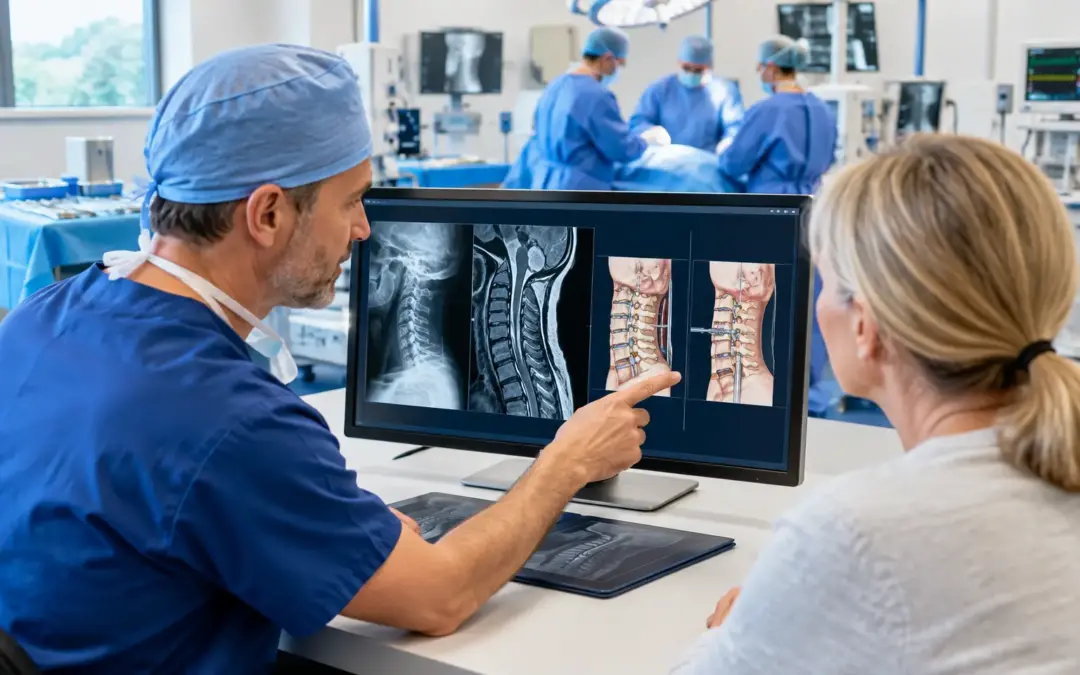
A cervical operation is never chosen simply because one incision is easier to make than another. In anterior versus posterior cervical surgery, the right approach depends on where the spinal cord or nerve roots are compressed, how many levels are involved, the alignment and stability of your neck, and whether preserving motion is a realistic goal.
For patients living with arm pain, numbness, weakness, loss of hand coordination, or spinal cord symptoms, this distinction can shape both the procedure and the recovery plan. A clear explanation from an experienced spine surgeon helps replace uncertainty with an informed, individualized decision.
What the Two Approaches Mean
Anterior cervical surgery reaches the cervical spine from the front of the neck. The surgeon carefully works through natural tissue planes to access the discs and vertebral bodies directly. This route is often used when a damaged disc, bone spur, or disc herniation is pressing on the spinal cord or nerve roots from the front.
The most familiar anterior procedures are anterior cervical discectomy and fusion, commonly called ACDF, and cervical artificial disc replacement. Both begin with removing the diseased disc and decompressing the nerves or spinal cord. With fusion, the surgeon places a graft or implant to support the space while the bones heal together. With artificial disc replacement, a motion-preserving implant may be placed instead when the anatomy and condition of the spine are appropriate.
Posterior cervical surgery reaches the spine from the back of the neck. It is commonly considered when compression extends across several levels, when the problem is primarily behind the spinal cord, or when the patient’s anatomy, alignment, or prior surgery makes a front approach less suitable. Procedures may include a laminectomy, laminoplasty, foraminotomy, or posterior fusion with stabilization.
Neither approach is inherently better. Each is a tool for treating a specific pattern of cervical disease.
Anterior Versus Posterior Cervical Surgery: The Key Difference
The central question is not where the scar will be. It is where the pressure is, how the spine is aligned, and what must be done to create lasting stability.
An anterior approach gives direct access to disc material and bone spurs located in front of the spinal cord. This can make it particularly effective for one or two levels of disc degeneration, a focal herniation, or nerve compression producing pain that travels into the shoulder, arm, or hand. It can also help restore disc height and, in selected cases, improve cervical alignment.
A posterior approach can provide wider access to multiple levels of the spinal canal without removing several discs from the front. For a patient with multilevel narrowing, especially when the neck retains a favorable curve, posterior decompression may allow the spinal cord room to move away from the areas of pressure. A posterior foraminotomy can also relieve a pinched nerve while preserving the disc in carefully chosen cases.
That said, a posterior operation is not automatically the more conservative option. Removing too much bone or operating in the setting of poor alignment can create or worsen instability. Some patients need posterior instrumentation and fusion to maintain support after decompression.
When an Anterior Approach May Be Recommended
An anterior procedure is often considered for localized disease that is clearly causing symptoms from the front of the spinal canal. A patient with a single-level disc herniation and severe arm pain, for example, may be a strong candidate for anterior decompression.
It may also be recommended when a collapsed disc is narrowing the openings where nerves exit the spine, or when correction of a forward-bent cervical alignment is part of the surgical objective. By restoring space at the disc level, the surgeon can address nerve compression while supporting the natural height and contour of the neck.
For eligible patients, cervical artificial disc replacement can offer an additional advantage: it is designed to maintain movement at the treated level. Motion preservation is not appropriate for every diagnosis. Significant arthritis of the facet joints, marked instability, severe deformity, osteoporosis, infection, and certain multilevel conditions may make fusion the safer choice. Still, when the clinical picture fits, disc replacement can be a sophisticated alternative to fusion.
Anterior surgery also has its own considerations. Because the incision is in the front of the neck, temporary swallowing discomfort or hoarseness can occur. These symptoms often improve, but they should be part of a straightforward preoperative discussion. The surgeon must also consider prior neck surgery, scar tissue, and the exact number of levels requiring treatment.
When a Posterior Approach May Be Recommended
Posterior surgery is frequently valuable for multilevel spinal stenosis, particularly when the spinal cord is compressed over a broad area. It may also be selected for compression affecting the nerve roots toward the side or back of the spine, including certain cases of foraminal stenosis.
A posterior cervical foraminotomy may relieve pressure on a nerve root without a fusion in selected patients. This can be appealing when the disc remains reasonably healthy and the compression is localized. However, it is not the right answer for every herniation or for substantial instability.
For more extensive narrowing, a laminectomy removes part of the bony arch over the spinal canal. A laminoplasty reshapes and opens that area while retaining some of the bone structure. If the neck is unstable, straightened, or at risk of developing deformity after decompression, posterior fusion may be recommended alongside the decompression.
Recovery can involve more muscle soreness after a posterior procedure because muscles in the back of the neck are moved to reach the spine. Some patients also experience temporary neck stiffness. Yet for the right diagnosis, the posterior route can provide the safest and most complete decompression available.
Alignment, Stability, and Number of Levels Matter
MRI findings are essential, but they are not the whole decision. Your surgeon will also review X-rays, sometimes including flexion-extension views, CT scans when bone detail is needed, your neurological examination, symptoms, and medical history.
Cervical alignment is especially influential. When the neck has a healthy forward curve, posterior decompression may work well for multilevel stenosis because the spinal cord can shift backward once room is created. If the neck is kyphotic, meaning it bends forward, posterior-only decompression may not adequately address pressure from the front. In that situation, an anterior procedure, a posterior fusion, or a combined approach may be considered.
The number of involved levels matters, but it does not dictate the answer by itself. A single level can sometimes require posterior treatment, while several levels may still be addressed effectively from the front. This is why a recommendation based only on a scan report, without a full review of your images and symptoms, is not enough.
Recovery Expectations and Travel Planning
Recovery is personal, but patients should expect activity restrictions and a gradual return to normal movement after either approach. Walking is often encouraged early, while lifting, driving, exercise, and work duties are reintroduced according to the procedure and the surgeon’s instructions. Fusion requires time for bone healing, whereas motion-preserving disc replacement has different activity and imaging follow-up needs.
For international patients, the surgical decision should include a practical recovery plan. Traveling too soon after surgery is not advisable, and arrangements should account for postoperative monitoring, safe transportation, medication management, and follow-up before the flight home. At Spinal Surgery Mexico, coordinated care can include hospital planning, English-speaking patient support, recovery lodging, and supervised postoperative assistance so patients are not left to manage a major procedure alone in an unfamiliar setting.
Cost should be transparent, but it should never be the only reason to select a procedure. Ask what the surgical package includes, whether implants and hospital services are clearly identified, how complications would be handled, and how your follow-up will continue once you return home.
Questions Worth Asking Your Surgeon
A meaningful consultation should make the recommendation understandable. Ask what structure is causing your symptoms, whether the spinal cord is involved, and what could happen if treatment is delayed. Ask why an anterior or posterior route is favored in your case, whether a motion-preserving option is appropriate, and whether fusion is necessary for stability.
You should also ask about the expected benefit for your specific symptoms. Surgery often has the clearest goal of relieving neurological compression, protecting spinal cord function, reducing radiating arm pain, or improving weakness. It may not eliminate every source of chronic neck pain, particularly when arthritis or muscular pain is also present.
The best surgical approach is the one that safely treats the compression, respects the mechanics of your spine, and supports the life you want to return to. Bring your questions, imaging, and goals to a qualified cervical spine specialist, then give yourself the confidence of making a decision based on your anatomy rather than a one-size-fits-all label.