
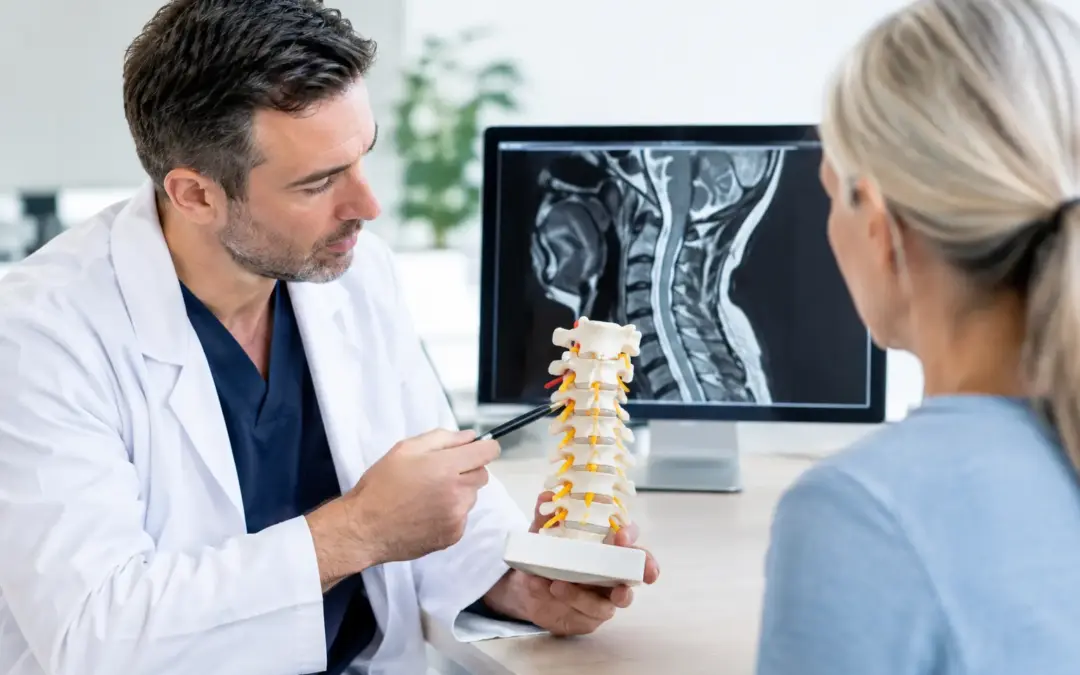
Neck pain alone does not answer the question of which patients need cervical fusion. Many people have disc degeneration on an MRI and never need surgery. Others have a compressed spinal cord, progressive arm weakness, or an unstable spinal segment that can no longer safely support normal movement. The difference is not simply how painful the neck feels. It is whether the anatomy is threatening nerve function, spinal stability, or day-to-day independence.
Cervical fusion can be a highly effective operation when it is carefully matched to the right diagnosis. It stabilizes painful or damaged vertebrae by joining them together, often after a surgeon removes a diseased disc or bone that is pressing on nerves or the spinal cord. The goal is not to fuse a spine because it looks worn on imaging. The goal is to relieve pressure, restore stability, and protect neurologic function when non-surgical care or motion-preserving surgery is no longer the safer choice.
Which Patients Need Cervical Fusion?
A patient may be a candidate for cervical fusion when there is clear structural disease that causes persistent symptoms or neurologic risk. The decision is based on a complete evaluation: symptoms, physical examination, MRI or CT imaging, X-rays that show movement of the spine, and the response to appropriate conservative treatment.
Fusion is often considered for patients with cervical radiculopathy, meaning a pinched nerve root that produces arm pain, tingling, numbness, or weakness. If symptoms continue despite medication, physical therapy, activity modification, or carefully selected injections, surgery may be appropriate. When the affected disc is severely collapsed, the segment is unstable, or there is extensive bone spur formation, fusion may offer more reliable support than a motion-preserving procedure.
It can also be necessary for cervical myelopathy, a condition in which the spinal cord itself is compressed. This deserves prompt specialist attention because the spinal cord controls far more than neck and arm sensation. Patients may notice clumsy hands, difficulty fastening buttons, dropping objects, gait imbalance, leg stiffness, falls, or changes in fine motor control. In advanced cases, waiting can allow permanent nerve damage to develop. Surgery is typically intended to stop progression and, when possible, allow function to improve.
Instability is a major reason for fusion
A healthy cervical spine has controlled movement between vertebrae. When one level slips abnormally, moves excessively, or loses the ability to maintain alignment, decompression alone may not be enough. Removing a disc, bone spur, or damaged joint can sometimes create or worsen instability. A fusion provides a stable foundation while the treated level heals.
Instability may arise from degenerative disc collapse, a prior surgery, trauma, deformity, or a condition such as spondylolisthesis. Dynamic X-rays, taken while bending forward and backward, can help reveal movement that a standard MRI may not show. In these cases, the question is not whether preserving motion sounds appealing. It is whether preserving motion at that particular level is medically sound.
Multi-level disease may change the surgical plan
Patients with disease at two or more cervical levels may still have options, but the choices become more individualized. A fusion may be recommended when multiple levels are severely degenerated, when there is major spinal cord compression, or when alignment needs to be corrected. For some people, combining procedures is possible, such as disc replacement at a suitable level and fusion at another level that is too damaged or unstable for an artificial disc.
This is why a recommendation should never be based on a one-size-fits-all rule. The number of levels involved matters, but so do the quality of the facet joints, bone health, spinal alignment, degree of arthritis, and the location of compression.
When Cervical Fusion May Not Be the First Choice
Cervical fusion is not the default treatment for every herniated disc or painful neck. Most patients begin with non-surgical care when there is no urgent neurologic concern. A period of guided physical therapy, anti-inflammatory medication when appropriate, targeted injections, and changes to aggravating activities may significantly reduce symptoms.
For a patient with a soft disc herniation at one level, preserved spinal motion, minimal facet arthritis, and no instability, cervical artificial disc replacement may be an excellent alternative. An artificial disc is designed to maintain movement at the treated level while relieving nerve or spinal cord pressure. For qualified candidates, this can reduce the mechanical stress that a fusion may place on nearby levels over time.
However, disc replacement is not automatically better simply because it preserves motion. Significant facet joint arthritis, osteoporosis, marked instability, severe deformity, advanced disc collapse, or certain multi-level conditions can make fusion the safer and more durable option. A skilled cervical spine surgeon should explain not only which procedure is recommended, but also why the alternatives may or may not fit your anatomy.
Symptoms That Require a Timely Surgical Evaluation
Not every symptom means emergency surgery, but progressive neurologic changes should not be managed by waiting to see if they disappear. Seek prompt medical evaluation for worsening arm or hand weakness, increasing numbness, new problems with balance or walking, loss of coordination, or pain that remains disabling despite appropriate treatment.
Urgent assessment is especially important after trauma or when symptoms include new bowel or bladder changes, severe gait deterioration, or rapidly worsening weakness. These symptoms can have several causes, but spinal cord compression must be ruled out quickly.
Pain severity matters, too. A person whose arm pain prevents sleep, work, driving, or basic self-care may be a reasonable surgical candidate even without dramatic weakness, provided imaging and examination confirm a surgically correctable source. Surgery should target a specific pain generator, not be used as a general solution for diffuse neck discomfort.
How Surgeons Decide Whether Fusion Is Appropriate
The strongest surgical recommendation comes when symptoms, examination findings, and imaging all point to the same cervical level or levels. For example, weakness in a particular muscle group, pain traveling in a recognizable pattern down the arm, and an MRI showing compression of the matching nerve root create a more confident clinical picture.
A surgeon will also consider your overall health and recovery needs. Smoking or nicotine use can interfere with bone healing after fusion. Poorly controlled diabetes, low bone density, previous neck surgery, and certain medications may affect surgical planning. These factors do not automatically prevent treatment, but they may require optimization before surgery or influence the recommended technique.
The expected benefit should be discussed honestly. Surgery for a compressed nerve often improves radiating arm pain more predictably than longstanding numbness or weakness. Surgery for myelopathy is frequently performed to prevent further decline, and improvement can vary according to how long the spinal cord has been compressed. A trustworthy consultation addresses both the potential gains and the limits of what surgery can restore.
What Recovery From Cervical Fusion Can Involve
Most cervical fusions use a front-of-neck approach called anterior cervical discectomy and fusion, or ACDF. The surgeon removes the damaged disc, decompresses the nerves or spinal cord, places a spacer or graft to support the disc space, and stabilizes the level with an implant when indicated. Some conditions require a different approach from the back of the neck, particularly when compression or instability has a different pattern.
Recovery plans vary by procedure, number of levels, bone quality, and individual health. Temporary swallowing discomfort and neck soreness are common after anterior surgery. Patients are typically encouraged to walk early, follow lifting and activity restrictions, and attend scheduled follow-up visits to confirm healing. Fusion itself develops over months, so protecting the surgical area during that period matters.
For patients traveling for care, planning should extend beyond the operating room. A safe experience includes preoperative imaging review, clear discussion with the surgeon, hospital standards, transportation support, appropriate recovery lodging, and postoperative monitoring before travel home. At Spinal Surgery Mexico, coordinated care is designed to give international patients a structured path through these practical decisions alongside specialist-led surgical evaluation.
Questions Worth Asking Before You Choose
Before agreeing to cervical fusion, ask what structure is causing your symptoms and how the surgeon knows it is responsible. Ask whether decompression alone, artificial disc replacement, or continued non-surgical treatment is reasonable in your case. You should also understand how many levels require treatment, what movement you may lose, what recovery restrictions apply, and what outcome is realistic for your particular neurologic symptoms.
The right operation is the one that addresses the actual problem while preserving as much healthy function as possible. If your neck condition is affecting your strength, balance, work, or confidence in everyday movement, a detailed review by an experienced cervical spine surgeon can turn a frightening decision into a clear, individualized plan.