
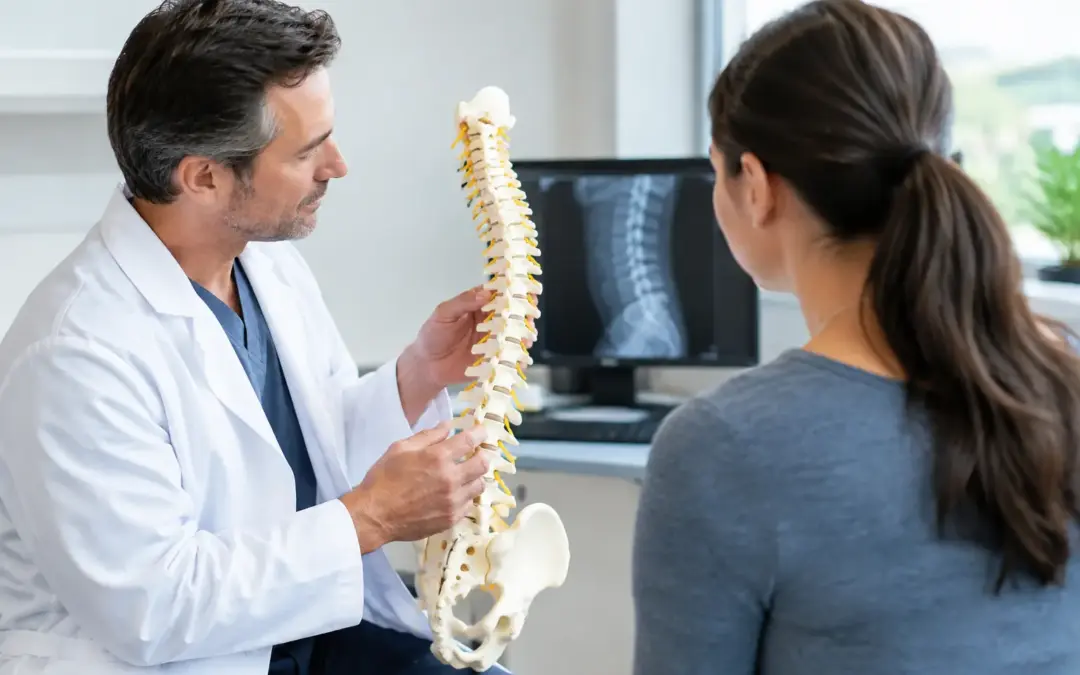
A pinched spinal nerve can make ordinary movements feel impossible: turning your head, walking through a grocery store, gripping a coffee cup, or sleeping through the night. So, when is decompression surgery needed? Usually, it is considered when pressure on the spinal cord or nerve roots is causing significant pain, weakness, loss of function, or progressive neurologic changes that have not responded to appropriate nonsurgical care.
Decompression surgery is not a treatment for every sore back or stiff neck. It is a carefully targeted procedure designed to create more room around compressed nerves. The decision should come from a thorough evaluation by a qualified spine specialist who connects your symptoms, physical examination, and imaging findings rather than relying on an MRI alone.
What spinal decompression surgery treats
The spinal canal is the protected passageway for the spinal cord and nerve roots. With age, injury, disc degeneration, arthritis, disc herniation, or thickened ligaments, the available space can narrow. This narrowing may irritate or compress a nerve root in the neck or low back. In more serious cervical cases, it can compress the spinal cord itself.
A decompression procedure removes or reshapes the structure causing pressure. Depending on the diagnosis, that may involve removing part of a herniated disc, trimming bone spurs, removing a small portion of the lamina, or relieving narrowing in the nerve passageways called the foramina. Procedures may be performed in the cervical, thoracic, or lumbar spine, though neck and lower-back conditions are most common.
The goal is not simply to make an image look better. The goal is to relieve nerve pressure, protect neurologic function, and help you return to safer, more comfortable movement.
When is decompression surgery needed instead of more conservative care?
Most patients do not begin with surgery. A period of guided nonsurgical treatment is often reasonable when symptoms are mild, stable, and there are no concerning neurologic signs. This may include medication, activity modification, physical therapy, targeted injections, or other pain-management strategies.
Surgery becomes more likely when those measures have not provided meaningful relief and the symptoms continue to limit work, sleep, walking, independence, or quality of life. The timeline varies. A painful lumbar disc herniation may improve over several weeks for one person but remain severely disabling for another. Spinal stenosis tends to be a longer-term problem, yet worsening walking tolerance or nerve deficits can change the calculation.
More importantly, some findings should not be managed with a wait-and-see approach. A surgeon may recommend earlier decompression when there is clear evidence of nerve damage or spinal cord compromise.
Symptoms that can make surgery more urgent
Seek prompt medical assessment for new or worsening symptoms such as:
- Progressive weakness in an arm, hand, foot, or leg
- Difficulty walking, poor balance, clumsiness, or frequent falls
- Loss of bladder or bowel control, or numbness in the groin or inner thighs
- Severe pain with a correlating disc herniation or stenosis that does not respond to treatment
The last two neurologic warning signs can indicate a time-sensitive emergency, particularly cauda equina syndrome in the lumbar spine. Not every episode of numbness is an emergency, but sudden changes in bladder or bowel function, saddle numbness, or rapidly worsening weakness should be evaluated immediately in an emergency setting.
Cervical spinal cord compression requires special attention
Neck problems are not always limited to neck pain. When narrowing in the cervical spine presses on the spinal cord, the condition is called cervical myelopathy. Symptoms may be subtle at first: trouble buttoning a shirt, dropping objects, handwriting changes, stiffness in the legs, balance changes, or a feeling that the hands are less coordinated.
In cervical myelopathy, surgery may be advised even if pain is not the main complaint. The reason is protective. Physical therapy and injections may help some symptoms, but they cannot remove ongoing pressure from the spinal cord. If the cord is at risk, decompression can help prevent further decline, although recovery depends on how long the compression has been present and how much nerve injury has already occurred.
The right operation depends on the location of the compression, spinal alignment, number of involved levels, bone quality, and whether the spine is stable. For selected patients, cervical artificial disc replacement can decompress a nerve while preserving motion at that level. In other situations, a fusion, posterior decompression, or a combined approach offers the safer and more durable result.
Imaging matters, but symptoms and examination matter more
Many adults have disc bulges, arthritis, or narrowing on an MRI without having symptoms. That is why a scan alone does not automatically mean surgery is needed. A surgeon must determine whether the abnormality matches the pattern of pain, numbness, weakness, reflex changes, or walking difficulty.
For example, a lumbar MRI may show narrowing at several levels, but only one level may correspond with pain shooting down the leg and weakness in a particular muscle group. Treating the wrong level will not solve the problem. Careful clinical correlation is one of the most important safeguards in spinal surgery.
A complete evaluation may include MRI or CT imaging, X-rays that assess alignment and instability, a neurologic examination, and sometimes nerve testing. Your medical history also matters. Diabetes, smoking, osteoporosis, prior surgery, blood-thinning medication, and other health conditions can influence both the recommended procedure and the recovery plan.
Decompression alone or decompression with stabilization?
One of the most consequential questions is whether the spine can remain stable after pressure is relieved. In some patients, a focused decompression alone is enough. This can preserve more normal anatomy and may allow a shorter recovery.
In others, the disc or joints are already too unstable, or removing the structures needed for decompression would create instability. In those cases, the surgeon may recommend stabilization with instrumentation or a fusion. A fusion can be highly effective when stability is the priority, but it does reduce motion at the treated level and may change stress on nearby segments over time.
For appropriately selected patients, motion-preserving options such as cervical disc replacement or lumbar stabilization may offer an alternative to traditional fusion. These technologies are not automatically better for every diagnosis. Severe facet arthritis, marked instability, deformity, osteoporosis, or multilevel disease may make a fusion or another approach more appropriate. The best procedure is the one that treats the compression while respecting the long-term mechanics of your spine.
Questions to ask before agreeing to surgery
A clear surgical recommendation should leave you understanding what is being treated and why. Ask your surgeon to explain which nerve or part of the spinal cord is compressed, how that explains your symptoms, and what could happen if you delay treatment.
You should also understand the proposed approach, whether decompression alone is sufficient, and why a motion-preserving procedure or fusion may be recommended. Discuss expected improvement realistically. Surgery is often very effective for arm or leg pain caused by a compressed nerve, and it may prevent worsening neurologic damage. It is less predictable for longstanding numbness, chronic back pain without a clear nerve source, or weakness that has been present for many months.
Every operation has risks, including infection, bleeding, spinal fluid leak, recurrent symptoms, incomplete relief, blood clots, and, in rare cases, nerve injury. A trustworthy surgical team will address these risks plainly, along with the precautions used to reduce them.
Planning surgery when you are traveling for care
For patients considering treatment outside the United States or Canada, clinical quality and continuity should guide the decision, not price alone. Before travel, your surgeon should review your imaging and health history, explain whether you are a candidate, and provide a clear plan for the procedure, hospital stay, rehabilitation, and follow-up.
At Spinal Surgery Mexico, care coordination can include specialist-led evaluation, hospital planning, English-speaking patient support, transportation guidance, and supervised postoperative recovery. That structure can be particularly valuable after spine surgery, when you should be focused on healing rather than trying to organize logistics in an unfamiliar setting.
Bring complete imaging, radiology reports, medication lists, prior treatment records, and details of any previous spine surgery. It is also wise to plan for the recovery period realistically. Even minimally invasive procedures require restrictions, walking progression, incision care, and follow-up before a long trip home.
The right time to seek a surgical opinion is before pain and nerve symptoms take more from your life. If weakness, balance changes, loss of function, or persistent radiating pain are limiting what you can do, a careful spine evaluation can give you clarity and a path forward.