
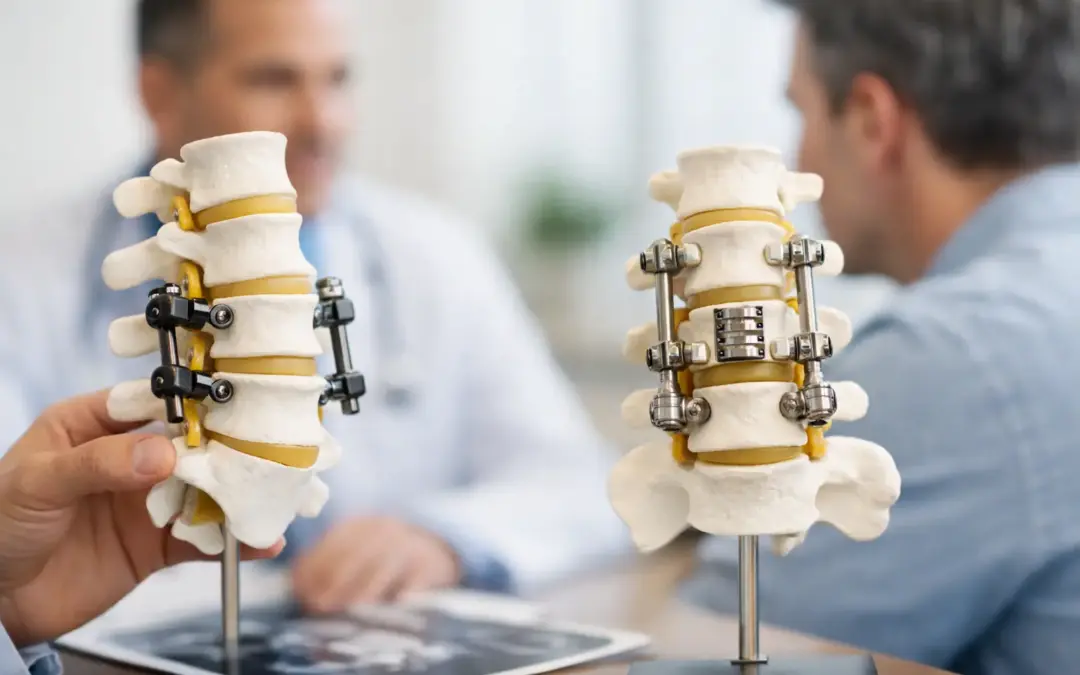
A recommendation for lumbar fusion can feel final: a painful disc or unstable spinal segment is fixed in place so it can no longer move. For some patients, that is the right solution. But lumbar stabilization instead of fusion may be worth discussing when the goal is to treat instability while preserving as much natural movement as safely possible.
This distinction matters to people whose back pain has narrowed everyday life – walking, working, sleeping, driving, or simply standing long enough to cook a meal. The best procedure is not automatically the most extensive one. It is the procedure that addresses the true source of pain or nerve compression while protecting long-term function whenever the anatomy allows.
What fusion does – and why it is sometimes necessary
Lumbar fusion joins two or more vertebrae so they heal into one solid bone. During a fusion, the surgeon may remove a damaged disc, decompress pinched nerves, place bone graft material, and use screws and rods to hold the area steady as it heals.
Fusion can be a highly effective treatment for significant spinal instability, severe deformity, advanced disc collapse, certain cases of spondylolisthesis, recurrent disc problems, or pain caused by movement at a badly damaged segment. When a spinal level cannot provide safe support on its own, eliminating motion at that level can protect nerves and restore stability.
The trade-off is that a fused segment no longer moves. Most patients can still return to active, fulfilling lives after fusion, but the adjacent levels above and below the fusion must absorb more motion over time. This does not mean adjacent-level degeneration will happen to every patient, and it does not mean fusion is a failure when it is medically necessary. It does mean that preserving motion can be an important consideration for appropriately selected patients.
When lumbar stabilization instead of fusion may help
Lumbar stabilization is a broad term for procedures and systems designed to support a painful or unstable spinal segment without fully eliminating its movement. Depending on the diagnosis, this may involve dynamic implants, interspinous devices, minimally invasive fixation strategies, or stabilization performed alongside decompression.
Rather than rigidly locking a spinal level, a motion-preserving stabilization approach is intended to control abnormal movement while allowing carefully limited, more natural motion. The goal is not to avoid fusion at all costs. The goal is to use a fusion alternative when it can safely provide the support a patient needs.
For the right candidate, potential advantages may include a less disruptive surgical approach, preservation of motion at the treated level, and reduced stress on neighboring segments. Recovery can also be more manageable than with a major multilevel reconstruction, although every operation has its own healing timeline and restrictions.
A stabilization procedure may be considered for patients with mild to moderate instability, lumbar spinal stenosis requiring decompression, selected cases of degenerative disc disease, or pain linked to a segment that needs support but is not completely structurally failed. It may also be considered when a patient wants to maintain mobility and imaging shows that a less rigid solution is medically reasonable.
The diagnosis matters more than the procedure name
Back pain is not one condition. Two people can both be told they have “degenerative changes” yet need entirely different treatments. One may have nerve compression from spinal stenosis. Another may have a slipped vertebra, facet joint deterioration, a collapsed disc space, scoliosis, or instability visible only when the spine bends and extends.
That is why a responsible surgical decision begins with a full review of symptoms, neurological findings, MRI or CT imaging, and standing X-rays. Dynamic flexion-extension X-rays can be especially useful because they show whether a vertebra shifts excessively during movement.
A surgeon must also determine whether the patient’s leg pain, numbness, weakness, or walking limitation is coming from nerve compression. In some cases, decompression alone may relieve pressure on the nerves. In others, removing bone or tissue to decompress the spine could create or worsen instability, making stabilization or fusion necessary.
The central question is not, “Can I avoid fusion?” It is, “What level of support does my spine need after the nerve compression or damaged tissue has been addressed?” That answer should be based on anatomy and function, not a one-size-fits-all treatment preference.
Who may not be a candidate for a fusion alternative
Motion-preserving lumbar treatment has clear limits. Severe instability, major vertebral slippage, substantial spinal deformity, extensive disc collapse, poor bone quality, infection, fracture, or complex multilevel disease may require a traditional fusion to create durable stability.
A patient with progressive muscle weakness, loss of bowel or bladder control, saddle numbness, or rapidly worsening neurological symptoms needs urgent medical evaluation. These symptoms can signal serious nerve compression and should never be delayed while considering elective treatment options or travel plans.
Previous surgeries also influence the decision. Scar tissue, failed hardware, recurrent disc herniation, and changes in alignment can make a case more complex. A stabilization system may still be possible in selected revision cases, but it must be evaluated individually.
Age alone does not decide candidacy. Many adults in their 60s and 70s are active, healthy candidates for minimally invasive spinal procedures. Bone density, overall health, alignment, the condition of the discs and facet joints, and personal activity goals usually matter far more than a number on a chart.
Questions to ask before choosing stabilization or fusion
Patients deserve a clear explanation of why a surgeon recommends one approach over another. Before making a decision, ask whether the painful level is truly unstable, whether decompression is needed, and whether preserving movement is realistic in your case.
It is also reasonable to ask what implant or technique is being proposed, how it is intended to work, and what the expected recovery restrictions will be. Ask about the chance that a stabilization procedure could later require fusion. No spinal operation can promise a permanent result, but a direct discussion about possible future treatment is part of informed care.
Cost and recovery logistics deserve the same clarity. Patients traveling from the United States or Canada should understand what is included in surgical planning, hospital care, medications, follow-up, lodging, ground transportation, and supervised recovery. A lower price should never mean less attention to safety, communication, or postoperative support.
A personalized path to lumbar care in Mexico
For international patients, arranging spine surgery can feel like another burden on top of chronic pain. Spinal Surgery Mexico coordinates specialist-led evaluation, hospital treatment, travel guidance, and monitored recovery so patients do not have to navigate an unfamiliar healthcare system alone.
Board-certified neurosurgeon Dr. Mario Salmon evaluates whether a minimally invasive stabilization approach, decompression, fusion, or another lumbar procedure best fits the patient’s imaging and symptoms. The recommendation should be clinically driven, even when a patient arrives hoping to avoid fusion. Honest guidance is a form of patient advocacy.
After surgery, recovery is not an afterthought. Patients may benefit from a structured period of rest, mobility guidance, symptom monitoring, and practical support before returning home. This added layer of care can be especially reassuring when the goal is to travel safely and begin rehabilitation with confidence.
Choosing between lumbar stabilization and fusion is not about selecting the newer or less invasive option by default. It is about finding a surgeon who will explain the trade-offs plainly, examine the evidence in your specific spine, and help you pursue the greatest possible comfort, stability, and freedom of movement.