
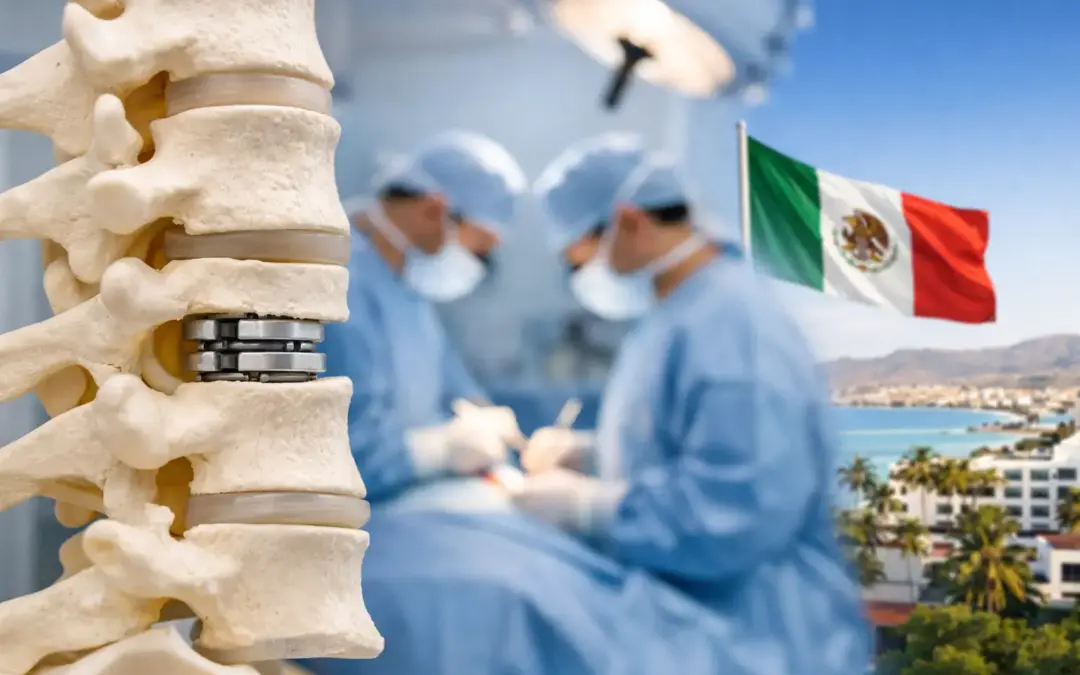
A painful, stiff neck can become much more than an inconvenience when arm tingling, weakness, headaches, or loss of coordination enter the picture. For patients researching cervical artificial disc replacement Mexico, the central question is usually not simply where surgery costs less. It is whether they can receive advanced, motion-preserving treatment from an experienced surgeon while having clear support before, during, and after travel.
Cervical artificial disc replacement is designed for selected patients whose damaged neck disc is compressing a nerve root or the spinal cord. Rather than permanently joining two vertebrae together, as happens in a fusion, the surgeon removes the diseased disc, relieves pressure on the nerves, and places an artificial disc intended to preserve movement at that spinal level.
For qualified patients, that distinction can matter deeply. The goal is not only to reduce nerve compression, but to help support a return to turning the head, driving, working, traveling, and handling daily life with greater confidence.
What Cervical Artificial Disc Replacement Treats
The cervical spine is the portion of the spine in the neck. Between its vertebrae are discs that cushion movement and help create space for nerves. With age, injury, repetitive strain, or degeneration, a disc may bulge, collapse, tear, or develop bone spurs around it. When this narrows the space around a nerve or the spinal cord, symptoms may include persistent neck pain, pain traveling into the shoulder or arm, numbness in the hand, weakness, or trouble with balance and fine motor control.
Surgery is generally considered after an appropriate evaluation and after conservative care, such as medication, physical therapy, activity modification, or injections, has not provided adequate relief. More urgent evaluation may be needed when neurological weakness is progressing, spinal cord compression is present, or balance and hand function are declining.
During artificial disc replacement, the surgeon approaches the cervical spine from the front of the neck. The damaged disc is removed and the compressed nerve structures are decompressed. An implant is then positioned between the vertebrae. The implant is designed to allow controlled motion rather than creating a solid bone bridge.
The procedure is not a cure for every source of neck pain. It is a targeted operation for a specific structural problem, and a careful review of imaging, symptoms, spinal alignment, bone quality, and medical history is essential.
Cervical Artificial Disc Replacement in Mexico vs. Fusion
Anterior cervical discectomy and fusion, often called ACDF, remains a proven and valuable operation. In fusion surgery, the problematic disc is removed and the adjacent bones are encouraged to heal together. For many patients, particularly those with instability, significant deformity, advanced arthritis, poor facet joints, or other complex findings, fusion may be the safer and more appropriate choice.
Artificial disc replacement is a sophisticated alternative when the anatomy supports it. Because it preserves motion at the treated level, it may help reduce the mechanical demands placed on the discs above and below. That potential benefit is one reason many active patients ask about it. Still, motion preservation is not automatically better for every person or every cervical condition.
The right procedure depends on the diagnosis, not on a preference for a particular implant. A trustworthy surgical recommendation should explain why disc replacement is appropriate, why fusion may be recommended instead, or why surgery may not yet be necessary.
Who May Be a Candidate?
Candidates often have one or two cervical discs causing nerve or spinal cord compression and have symptoms that match their MRI or other diagnostic imaging. They typically have adequate bone quality, reasonably preserved movement at the affected level, and no major instability or severe facet joint disease.
Patients may be less suitable for a disc implant if they have osteoporosis, marked spinal instability, advanced degenerative changes in the small joints behind the disc, severe deformity, infection, certain inflammatory conditions, or compression across multiple levels requiring a different strategy. Previous neck surgery can also affect the decision, though it does not automatically rule out treatment.
A remote review of records can be a useful starting point, but it does not replace the surgeon’s full clinical assessment. Patients should be prepared to share recent MRI images and reports, X-rays if available, a summary of symptoms, prior treatments, medications, and relevant medical conditions.
Why Patients Consider Mexico for Cervical Surgery
Many Americans and Canadians face an uncomfortable gap between needing specialized spine care and being able to access it promptly. Insurance may deny or limit coverage, deductibles can be high, wait times may be long, and out-of-pocket estimates for advanced cervical surgery can feel out of reach.
Mexico can offer a more accessible path to treatment, but the decision should never rest on price alone. International patients should look closely at the surgeon’s qualifications and experience, the hospital where surgery will take place, the implant being used, the details included in the surgical package, and the plan for follow-up after they return home.
At Spinal Surgery Mexico, care is coordinated around a board-certified neurosurgeon, Dr. Mario Salmon, with a focus on advanced cervical and spine procedures. Patients are supported by an English-speaking consultant who helps organize records, answer practical questions, coordinate travel details, and provide clarity around the surgical process. That structure is especially valuable when patients are managing a serious health decision away from home.
A Coordinated Path From Evaluation to Recovery
Traveling for spine surgery should not mean navigating an unfamiliar healthcare system alone. A well-organized care plan begins before the trip, with review of imaging and medical information, discussion of possible treatment options, and transparent preparation for what the procedure and recovery may involve.
Once a patient is approved for surgery, coordination may include hospital scheduling, transportation guidance, assistance with lodging, and preoperative instructions. Patients should understand what is included in their care plan and which items, if any, require separate payment. They should also ask about the implant system, anesthesia services, medications, possible additional testing, and follow-up arrangements.
After cervical disc replacement, many patients are encouraged to walk soon after surgery under medical guidance. The exact timeline varies with the number of levels treated, the condition of the spinal cord and nerves before surgery, overall health, and the surgeon’s instructions. Some patients may wear a soft collar briefly, while others may not need one. Heavy lifting, high-impact activity, and sudden neck strain are usually restricted during early healing.
Supervised postoperative recovery can provide welcome reassurance during the first days after discharge. Rather than immediately facing airports, unfamiliar transportation, or the demands of home, patients can recover in a comfortable setting with monitoring and access to support. San Miguel de Allende offers a calm environment for this stage of care, while the clinical team remains focused on safe recovery and appropriate follow-up.
Questions Worth Asking Before You Commit
A confident decision comes from specific answers, not broad promises. Ask who will perform the surgery, how often they treat your condition, and why the recommended procedure fits your imaging. Ask where surgery is performed, what emergency resources are available, and how your postoperative progress will be monitored.
It is also reasonable to ask about realistic outcomes. Disc replacement may relieve arm pain and neurological symptoms caused by compression, but recovery can be gradual. Long-standing nerve irritation may take time to improve, and no surgeon can guarantee that every symptom will disappear. Neck pain can have more than one cause, including muscle strain, arthritic joints, or adjacent-level degeneration.
Finally, make a plan for the trip home and ongoing care. Know when it is safe to fly, what records you will receive, how to contact the care team after returning home, and when to seek urgent medical attention. New or worsening weakness, loss of coordination, fever, wound drainage, swallowing difficulty, or breathing problems require prompt medical evaluation.
Choosing cervical surgery is a personal decision with real medical, financial, and practical considerations. The most helpful next step is a careful review of your records by a qualified spine specialist who can tell you whether preserving motion with an artificial disc is truly the right path for your neck, your health, and the life you want to return to.