
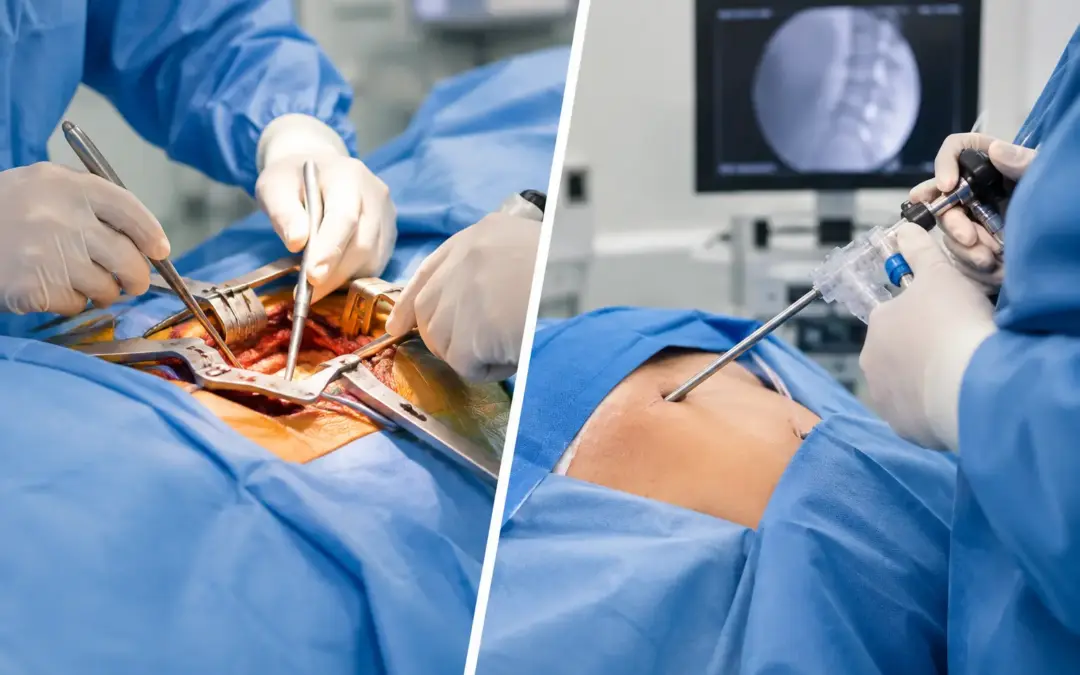
A smaller incision can be appealing when back or neck pain has already taken so much from your daily life. But open versus minimally invasive spine surgery is not simply a choice between a large scar and a small one. The right approach depends on what is causing nerve compression, instability, deformity, or loss of motion – and what must be done to treat it safely.
For patients considering spine surgery in Mexico, the most reassuring answer is not a promise that every procedure can be minimally invasive. It is a careful recommendation from an experienced spine surgeon who can explain the goals of treatment, the alternatives, and the recovery each option may require.
What Is Open Spine Surgery?
Open spine surgery describes a traditional surgical approach in which the surgeon makes an incision large enough to directly view and access the area of the spine being treated. Muscles and other soft tissues may need to be moved aside to expose the bone, discs, nerves, or joints.
“Open” does not mean outdated or inferior. In many situations, it is the most appropriate and safest way to address a serious spinal problem. A surgeon may recommend an open approach when the procedure involves multiple spinal levels, significant deformity, revision surgery after a prior operation, extensive instability, tumor removal, infection, or complex nerve compression.
Direct visualization can be especially valuable when anatomy is altered or when the surgeon needs broad access to correct a condition thoroughly. The trade-off is that greater tissue exposure can mean more postoperative soreness, more blood loss in some procedures, and a longer initial recovery period.
What Is Minimally Invasive Spine Surgery?
Minimally invasive spine surgery uses smaller incisions and specialized instruments to reach the spine while limiting disruption to surrounding muscles and soft tissues. Depending on the procedure, the surgeon may work through a tubular retractor, use surgical microscopy, fluoroscopic X-ray guidance, or other imaging tools to guide treatment precisely.
The goal is not merely a smaller incision. It is to accomplish the same necessary surgical objective while preserving as much healthy tissue as possible. For appropriate candidates, minimally invasive techniques may be used for decompression, discectomy, selected fusions, stabilization procedures, and some lumbar conditions.
Potential benefits can include less muscle injury, reduced postoperative pain, lower blood loss, a shorter hospital stay, and a faster return to comfortable movement. These are meaningful advantages, particularly for patients traveling from the United States or Canada who want a carefully managed path from surgery through recovery.
Still, minimally invasive does not mean minor surgery. A decompression or stabilization procedure remains a major medical decision, and recovery still requires patience, activity restrictions, follow-up, and a plan tailored to your condition.
Open Versus Minimally Invasive: The Differences That Matter
The most visible difference is incision size, but patients should focus on the issues beneath the skin: how much access the surgeon needs, which structures must be treated, and whether the chosen approach gives the best chance of a durable result.
Surgical access and precision
Open surgery provides a wider view of the surgical field. This may be necessary when several levels need treatment or when a surgeon must correct alignment, remove extensive compression, or work around scar tissue from a previous surgery.
Minimally invasive surgery reaches the target through a narrower corridor. With the right imaging and surgical expertise, this can provide excellent precision for selected conditions. However, a narrow corridor is not ideal for every anatomy or every procedure. The safest operation is the one that gives the surgeon adequate access to fully address the problem.
Muscle disruption and early recovery
Because traditional open techniques may require more muscle dissection, patients can experience more soreness during the early healing period. Recovery can still be successful, but it may take longer to regain comfortable mobility and stamina.
Minimally invasive approaches are designed to limit injury to muscles and soft tissues. Many suitable candidates find they can mobilize sooner and may require less time in the hospital. Individual results vary based on age, overall health, the number of levels treated, bone quality, smoking status, and the complexity of the underlying condition.
Pain, scarring, and blood loss
Smaller incisions often mean less visible scarring and may reduce early postoperative discomfort. Blood loss may also be lower with a minimally invasive approach. These are real benefits, but they should never be the only reasons to choose a procedure.
Long-term pain relief and function depend more on accurate diagnosis and effective treatment of the pain generator than on incision length alone. If a larger exposure is required to decompress nerves completely or create stable alignment, choosing a smaller approach simply for cosmetic reasons can be the wrong compromise.
Hospital stay and travel planning
Some minimally invasive procedures allow for a shorter hospital stay and a more efficient recovery timeline. That can be valuable for medical travelers. Yet international patients should not plan around an idealized timetable. You need enough time for early monitoring, wound assessment, pain management, safe walking, and clearance to travel.
A coordinated recovery plan matters as much as the operation itself. At Spinal Surgery Mexico, patients can receive support with hospital coordination, transportation, recovery lodging, and supervised postoperative care so they are not left to manage an unfamiliar setting alone after surgery.
Which Patients May Be Candidates for Minimally Invasive Surgery?
A minimally invasive option may be considered for patients with conditions such as a herniated disc causing nerve pain, spinal stenosis requiring decompression, selected cases of lumbar instability, or certain degenerative conditions that need stabilization or fusion.
Candidacy is determined by imaging and a detailed clinical evaluation, not by symptoms alone. An MRI or CT scan may show whether compression is localized, whether there is instability, how many levels are involved, and whether prior surgery has changed the anatomy. Your neurological symptoms also matter. Weakness, numbness, gait changes, loss of hand function, or bowel and bladder symptoms require timely medical assessment.
For cervical spine conditions, the conversation may also include motion-preserving alternatives. Cervical artificial disc replacement can be an option for carefully selected patients with disc disease at one or more levels. Unlike fusion, it is designed to preserve movement at the treated level. It is not classified simply as “minimally invasive” or “open” in the way many lumbar procedures are, but it reflects the same principle: choose the treatment that best protects function when clinically appropriate.
When an Open Approach May Be the Better Choice
Patients sometimes feel disappointed when told they are not candidates for minimally invasive surgery. That response is understandable, especially when quick recovery is a priority. But a surgeon who recommends an open approach may be protecting your long-term outcome.
Open surgery may be preferred when correction requires broad exposure, when several vertebral levels must be addressed, when there is substantial deformity or instability, or when revision surgery involves scar tissue and existing hardware. It can also be necessary when a minimally invasive technique would limit the surgeon’s ability to safely decompress nerves or secure implants.
The question is not, “Can this be done through the smallest incision?” A better question is, “Which approach gives me the safest and most complete treatment for my specific diagnosis?”
Questions to Ask During Your Surgical Consultation
A quality consultation should make the recommendation understandable. Ask what structure is causing your symptoms, what happens if you delay treatment, and whether nonsurgical care remains reasonable. If surgery is recommended, ask why a minimally invasive or open approach is being proposed, what alternatives exist, and what recovery will realistically look like.
You should also understand whether decompression alone is enough or whether stabilization, fusion, or a motion-preserving procedure is recommended. These choices affect movement, recovery, and the long-term demands placed on nearby spinal levels.
For patients traveling internationally, practical questions deserve clear answers as well: how long you should remain near the surgical team, who monitors you after discharge, when you can fly, what records you will receive, and how follow-up is handled once you return home. Experienced coordination does not replace medical judgment, but it can make an already difficult decision far less overwhelming.
A Treatment Plan Should Fit Your Spine, Not a Marketing Label
Minimally invasive surgery can offer important advantages for the right patient. Open surgery can offer the access and control needed for more complex treatment. Neither label should decide your care before a qualified surgeon has reviewed your symptoms, imaging, medical history, and goals for mobility.
The most valuable next step is a thorough consultation that replaces assumptions with a clear surgical plan – one built around relief of nerve pressure, stable movement, and a recovery path you can approach with confidence.