
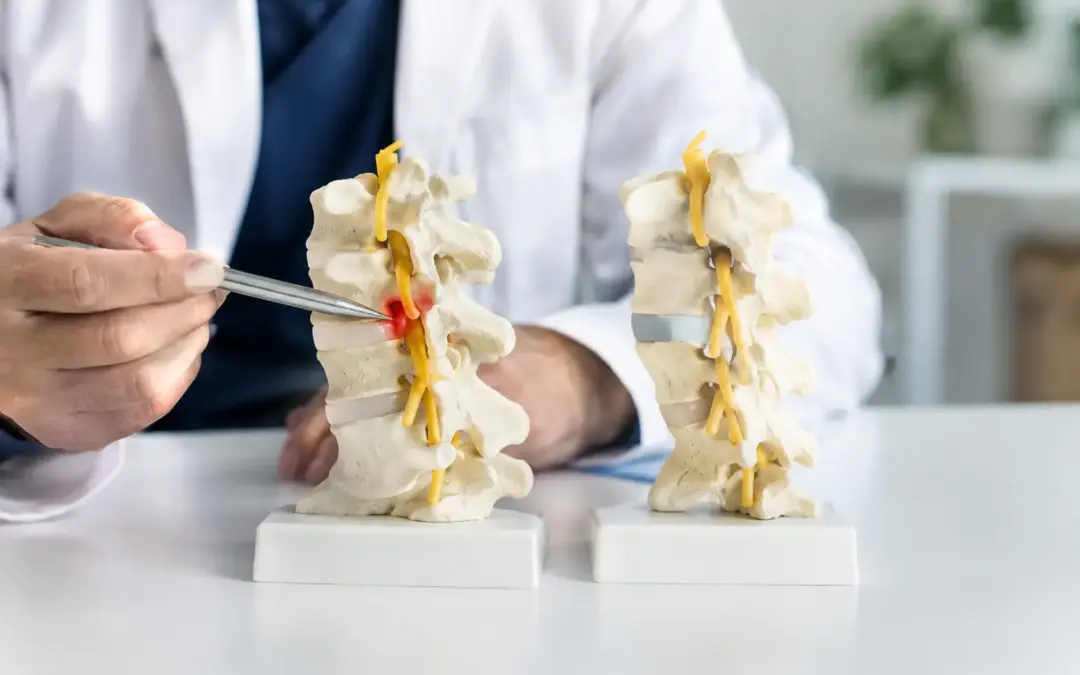
A scan may show both a disc herniation and spinal narrowing, but that does not mean every painful structure needs the same operation. Understanding laminectomy versus discectomy procedures starts with one essential question: what is pressing on the nerve, and how much space must be restored to relieve it? The answer shapes the surgical approach, the expected recovery, and whether a motion-preserving or stabilizing procedure should also be considered.
Both operations are forms of spinal decompression. Their purpose is to reduce pressure on a spinal nerve or, in some cases, the spinal cord. Yet they address different sources of compression. A discectomy primarily removes disc material. A laminectomy primarily removes bone at the back of the spinal canal. Some patients need one procedure; others need a carefully planned combination.
Laminectomy versus discectomy procedures: the key difference
A discectomy removes the portion of an intervertebral disc that has bulged, ruptured, or migrated into an area where it irritates a nerve. In the lumbar spine, this often causes sciatica – pain, tingling, numbness, or weakness traveling from the low back into the buttock, leg, or foot. In the cervical spine, a disc herniation can cause neck pain along with arm symptoms, hand numbness, or weakness.
A laminectomy removes all or part of the lamina, the thin plate of bone forming the back wall of the spinal canal. It creates more room for neural structures when the canal has become crowded. This narrowing, known as spinal stenosis, may develop from age-related bone changes, thickened ligaments, facet-joint enlargement, disc bulging, or a combination of these factors.
Put simply, a discectomy targets a problem disc. A laminectomy creates space within a narrowed canal. The two procedures may overlap because a surgeon sometimes needs to remove a small amount of lamina to safely reach a herniated disc. That limited access work is not necessarily the same as a full laminectomy for stenosis.
When a discectomy may be recommended
Discectomy is often considered when symptoms clearly match a disc herniation seen on MRI or other imaging and non-surgical care has not provided adequate relief. Physical therapy, activity modification, medication, and injections can be appropriate first steps for many patients. Surgery becomes more urgent when nerve compression is causing progressive weakness, severe disabling pain, or concerning changes in bladder or bowel function.
The ideal candidate is not simply someone with an abnormal disc scan. Disc bulges are common, including in people without symptoms. A surgeon must connect the imaging findings with the pattern of pain, neurological exam, symptom duration, and the patient’s daily limitations.
For a contained or localized lumbar disc herniation, a minimally invasive microdiscectomy may be an option. This approach uses a smaller incision and specialized visualization to remove the offending disc fragment while preserving as much surrounding tissue as possible. It can be highly effective for leg-dominant pain caused by a single compressed nerve root, but it does not reverse generalized arthritis, spinal instability, or widespread stenosis.
When a laminectomy may be recommended
Laminectomy is more commonly used for spinal stenosis, particularly when several structures are narrowing the canal. Symptoms can look different from a classic acute disc herniation. Lumbar stenosis often produces leg heaviness, aching, numbness, weakness, or cramping that worsens with standing and walking and improves with sitting or leaning forward. Some people find they can walk farther while pushing a shopping cart than while standing upright.
In the neck, stenosis may threaten the spinal cord itself. Signs can include impaired balance, clumsy hands, changes in handwriting, difficulty with buttons, weakness, or an electric-shock sensation with certain neck movements. These symptoms deserve timely specialist evaluation because spinal cord compression can progress.
A laminectomy can be performed at one level or multiple levels, depending on where narrowing is present. The amount of bone and soft tissue removed matters. Removing too little may fail to adequately decompress the nerves; removing too much in a spine that is already unstable can increase the risk of postoperative instability. That is why planning should include standing X-rays when appropriate, detailed MRI review, and a clear assessment of alignment and motion.
Could you need both procedures?
Yes. A patient may have a herniated disc within a canal already narrowed by bone, ligaments, and arthritic joints. In that setting, removing disc material alone may not create sufficient room for the nerve. A surgeon may perform a laminectomy or more limited laminotomy together with a discectomy to achieve a complete decompression.
The opposite can also be true: imaging may show broad stenosis, but one focal disc fragment is the true source of sudden nerve pain. The surgical plan should be built around symptoms and anatomy, not around the longest list of findings on a radiology report.
Decompression also raises a larger question: will removing pressure compromise stability? If a significant portion of a facet joint must be removed, or if the spine already slips abnormally, decompression alone may not be enough. In selected patients, stabilization, fusion, or a motion-preserving alternative may be discussed. These decisions are especially important for international patients, who need a plan that considers not only surgery but also safe travel and supported recovery.
Recovery: similar goal, different pace
Recovery after either procedure depends on the spinal region treated, the number of levels, the surgical technique, the patient’s baseline conditioning, and whether stabilization is added. A limited lumbar discectomy generally involves less tissue disruption than a multilevel laminectomy, so early recovery can be quicker. Many patients walk the day of or the day after surgery, with gradual increases in activity under their care team’s guidance.
Leg pain from a compressed nerve may improve quickly after discectomy, sometimes immediately. Numbness and weakness can take longer because irritated nerves heal slowly. If nerve damage has been longstanding, complete recovery cannot be guaranteed even after technically successful decompression.
Following a laminectomy, patients may experience incisional soreness and muscular stiffness while the back heals. Walking is usually encouraged in short, frequent intervals. Restrictions on lifting, bending, driving, work, and travel vary widely. A patient having a single-level decompression may have a very different timeline from someone receiving multilevel surgery with stabilization.
For patients traveling from the United States or Canada, the recovery plan should be discussed before booking flights. That includes how long to remain near the surgical team, who will monitor the incision and neurologic status, when it is safe to fly, how medications will be managed, and what follow-up will look like at home. A surgical package is most reassuring when it includes clear clinical oversight rather than leaving patients to arrange recovery alone.
Risks and trade-offs to discuss honestly
No spinal procedure is risk-free. Potential complications of both laminectomy and discectomy include infection, bleeding, blood clots, spinal fluid leak, nerve injury, anesthesia-related complications, and persistent or recurrent symptoms. The individual likelihood depends on the operation, health history, smoking status, diabetes control, bone health, and other factors.
Discectomy has a specific risk of recurrent disc herniation at the same level. It can relieve nerve compression, but the remaining disc may continue to degenerate over time. Laminectomy can leave back pain unchanged if that pain is driven by disc degeneration, facet arthritis, or instability rather than nerve pressure alone. In some cases, extensive decompression can contribute to a need for later stabilization.
The trade-off is not simply “smaller surgery is better” or “more surgery is more complete.” The right operation is the least invasive procedure that can adequately treat the confirmed source of neurological compression while protecting long-term spinal function. A skilled surgeon should explain what will be removed, what will be preserved, and why an alternative procedure is or is not appropriate.
Questions that lead to a better surgical decision
Before consenting to either operation, ask whether your symptoms match the level identified on imaging and whether there is objective weakness or spinal cord involvement. Ask whether the plan is a full laminectomy, a partial laminotomy, a microdiscectomy, or a combination. It is also reasonable to ask whether your spine shows instability, whether decompression could create instability, and whether a motion-preserving or stabilizing procedure should be considered.
For medical travelers, practical questions carry equal weight. Confirm the surgeon’s credentials and experience with your specific condition, the hospital standards, what is included in the quoted cost, the length of local recovery recommended, and how postoperative concerns will be handled. At Spinal Surgery Mexico, coordinated care is designed to help patients evaluate these clinical and travel details with a dedicated support structure around treatment.
The most useful next step is not choosing a procedure name from a scan report. It is obtaining a careful surgical review that explains the pressure on your nerves, the function you hope to regain, and the treatment plan that gives you the clearest path back to comfortable movement.