
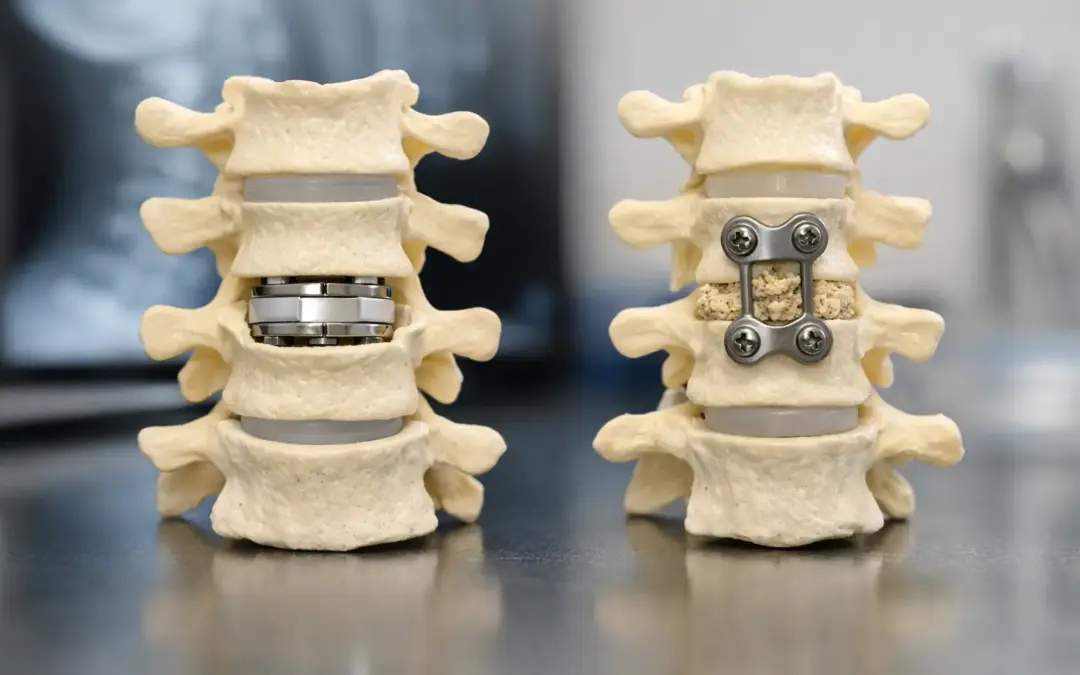
A painful cervical disc can make ordinary movements feel calculated: checking a blind spot, looking down at a phone, reaching for a shelf, or sleeping through the night. When nonsurgical care has not relieved nerve compression, cervical disc replacement vs fusion becomes a central question. Both operations can relieve pressure on the spinal cord or nerve roots, but they accomplish stabilization in different ways and suit different patients.
The right procedure is not simply the newest option or the least expensive one. It depends on the condition of the disc, the alignment and stability of the neck, the number of involved levels, bone quality, arthritis, prior surgery, and the symptoms shown on imaging and neurological examination.
What the surgeon is treating
Cervical discs sit between the bones of the neck. They act as cushions while allowing the neck to bend, rotate, and absorb everyday forces. With degeneration, injury, or herniation, disc material and bone spurs can narrow the space around a nerve root or the spinal cord.
That compression may cause neck pain, pain radiating into the shoulder or arm, numbness, tingling, weakness, loss of hand coordination, or balance problems. In more serious cases, spinal cord compression can progress and requires timely specialist evaluation.
In both cervical artificial disc replacement and anterior cervical discectomy and fusion, the surgeon generally approaches the spine through the front of the neck. The damaged disc is removed, and the compressed nerve or spinal cord is carefully decompressed. The key difference is what replaces the disc afterward.
Cervical disc replacement preserves motion
With cervical disc replacement, the surgeon places an artificial disc implant between the vertebrae after removing the diseased disc. The purpose is to maintain controlled movement at that level while restoring disc height and relieving compression.
For an appropriate candidate, this motion-preserving design may feel especially appealing. The neck is not meant to be rigid, and preserving movement at one or two treated levels can help maintain more natural mechanics. Some patients also value the possibility of returning to activities that involve turning the head frequently, such as driving, working, or traveling.
Research comparing artificial disc replacement with fusion has found that disc replacement can provide comparable or favorable outcomes for carefully selected patients, including pain relief, function, and reoperation rates in certain populations. However, those findings do not mean every painful disc should receive an artificial implant.
A disc replacement requires a level that can still function as a motion segment. If the facet joints behind the disc are severely arthritic, if there is major instability, or if the spine has advanced collapse or deformity, preserving motion may not be beneficial or technically appropriate.
Who may be a candidate for disc replacement?
Candidates often have one or two levels of cervical disc disease causing nerve or spinal cord compression, with symptoms that match the imaging findings. They typically have reasonable spinal alignment, no major instability, and no severe facet joint degeneration at the planned level.
Age alone does not determine candidacy. A healthy older adult with a well-preserved motion segment may still be considered, while a younger patient with severe arthritis or instability may be better served by fusion. The quality of the bone, the shape of the vertebrae, previous cervical surgery, and the exact location of compression all matter.
Cervical fusion creates dependable stability
In a fusion procedure, commonly called ACDF, the diseased disc is removed and the surgeon places a spacer or graft material between the vertebrae. A plate, screws, or another fixation system may be used depending on the surgical plan. Over time, the two vertebrae are intended to heal together into one stable segment.
Fusion has been performed for decades and remains an excellent, proven operation for many cervical conditions. It is often the better choice when the spine needs structural correction or stability rather than motion preservation. This can include significant disc collapse, instability, kyphotic alignment, advanced arthritis, certain traumatic injuries, or multilevel disease that is not suitable for disc replacement.
The trade-off is straightforward: a fused level no longer moves. For a single-level fusion, many patients retain very good overall neck function because the remaining cervical levels continue to move. Still, the loss of motion becomes more noticeable as additional levels are fused.
Fusion also requires bone healing. Nicotine use, poorly controlled diabetes, osteoporosis, certain medications, and nutritional concerns can affect healing risk. A surgeon may request that a patient stop nicotine products well before surgery and throughout recovery because successful fusion depends on the body forming bone across the treated level.
Cervical disc replacement vs fusion: the practical differences
The most visible distinction is motion. Disc replacement is designed to preserve it, while fusion intentionally eliminates motion at the treated segment to create stability. But the decision reaches beyond that single point.
Disc replacement avoids the need for the two vertebrae to grow together, so the recovery process is not centered on fusion healing. Many patients can begin gentle neck motion earlier, although every surgeon’s activity restrictions differ. Fusion patients may have somewhat more restrictions while the bone heals, and some may be advised to wear a collar for a period of time.
Both procedures can involve postoperative throat soreness, swallowing discomfort, neck stiffness, and fatigue in the early recovery period. Nerve symptoms may improve quickly after decompression, but numbness or weakness can take weeks or months to recover depending on how long the nerve was compressed before surgery.
Neither operation guarantees complete relief of every source of neck pain. Symptoms caused by muscle strain, widespread arthritis, shoulder disease, peripheral nerve conditions, or chronic pain sensitization may not resolve simply because a disc is treated. A careful diagnosis protects patients from expecting surgery to solve a problem it was not designed to address.
Risks deserve a direct conversation
All cervical spine surgery carries potential risks, even in experienced hands. These may include infection, bleeding, blood clots, anesthesia complications, hoarseness, swallowing difficulty, nerve injury, spinal cord injury, persistent symptoms, and the need for additional surgery.
Disc replacement has implant-specific considerations. The device can wear, shift, develop bone growth around it, or lose its intended range of motion over time. Fusion has different concerns, including failure of the bones to fuse, hardware issues, and stress changes at levels above or below the fusion.
The idea that fusion automatically causes adjacent-level degeneration is too simplistic. Nearby levels can degenerate naturally over time because the same aging and disc disease process may already be present. At the same time, preserving motion with a disc replacement may be a meaningful advantage for certain well-selected patients. The appropriate choice should be based on anatomy and long-term goals, not a one-size-fits-all promise.
Questions to bring to your surgical consultation
A productive consultation should leave you clear on the diagnosis, not just the procedure name. Ask your surgeon to explain which level is causing the symptoms, whether there is spinal cord compression, and why the proposed operation matches your anatomy.
It is also reasonable to ask whether you are a candidate for artificial disc replacement, what factors support or rule it out, how many levels require treatment, and what motion you can realistically expect afterward. Discuss the implant or fusion construct being considered, the expected recovery timeline, travel limitations, medication plan, and signs that require urgent follow-up.
For patients traveling for care, the planning conversation should also cover hospital standards, surgeon credentials, imaging review before travel, postoperative monitoring, and where recovery will take place. At Spinal Surgery Mexico, coordinated support can help international patients organize those practical details alongside a specialist-led surgical evaluation.
Choosing the operation that fits your spine
The strongest decision is not “disc replacement whenever possible” or “fusion because it is familiar.” It is the procedure that fully decompresses the affected nerves or spinal cord while respecting the mechanical needs of your individual cervical spine.
If a motion-preserving implant is a sound option, it may offer an opportunity to treat the diseased disc without sacrificing movement at that level. If fusion provides the safer and more durable correction for your anatomy, it can be the right path to stability, function, and relief. Bring your scans, symptoms, medical history, and daily goals to an experienced cervical spine specialist – the best surgical plan should make sense not only on an X-ray, but in the life you want to return to.